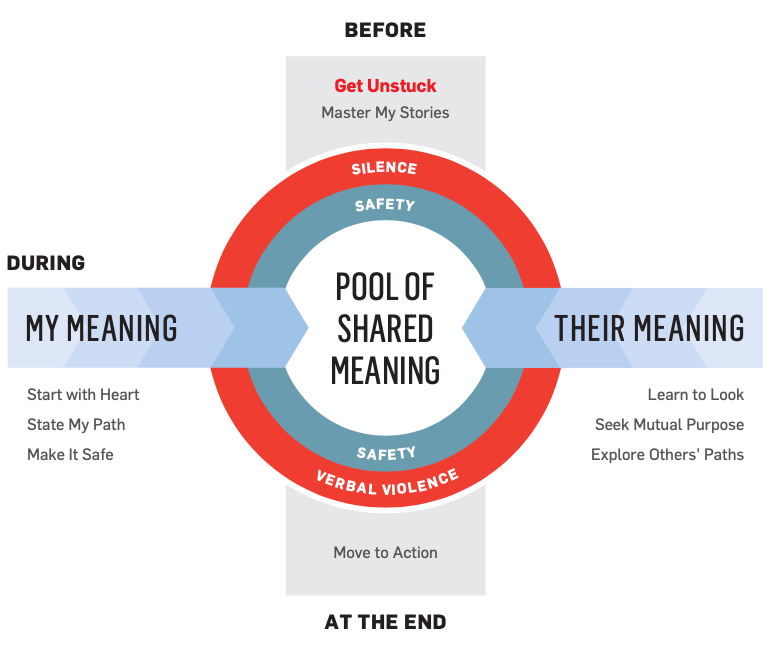
 Before:
- Get Unstuck
- Master My Stories
During (my meaning)
- Start with Heart
- State My Path
- Make it Safe
During (their meaning)
- Learn to Look
- Seek Mutual Purpose
- Explore Others’ Paths
At The End
- Move to Action
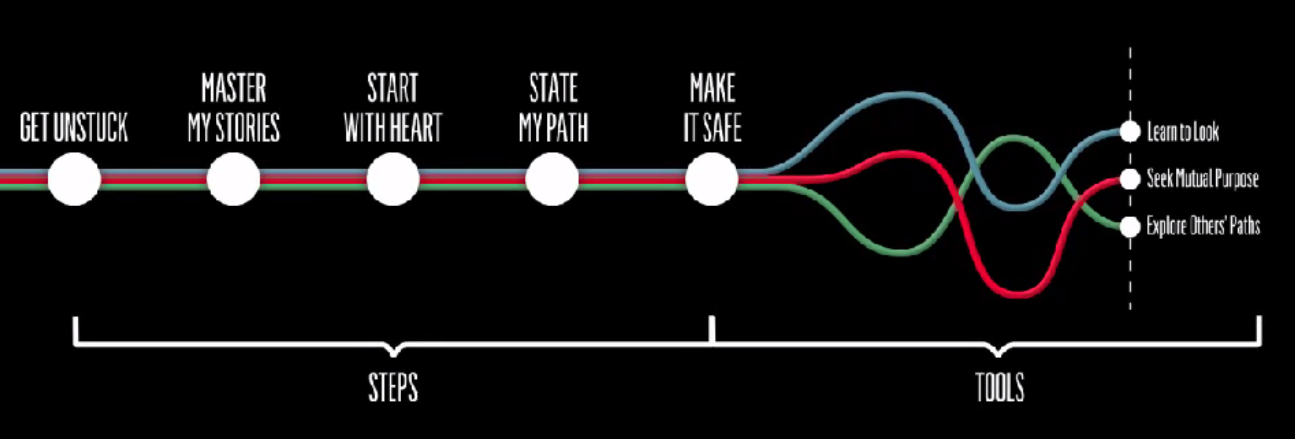
steps: use them in order
- Get Unstuck
- Master My Stories
- Start with Heart
- State My Path
- Make it Safe
tools: use when situation calls for it
- Learn to Look
- Seek Mutual Purpose
- Explore Others’ Paths
models
- Model: crucial conversation
- Model: fool’s choice
- Model: CPR
- Model: path to action & retracing your path
- Model: downward spiral
- Model: fact vs story
- Model: types of story
- Model: clever stories
- Model: what do I really want
- Model: silence or violence
- Model: purpose vs strategy.
- Model: automatic reactions when at odds
- Model: power listening tools (AMPP)
- Model: how to disagree (ABC)
- Model: 4 elements of a useful action
Quote: The first thing that deteriorates is not our behavior but our intent.
Quote: If you don’t talk it out, you will act it out.
Quote: The way we initiate a conversation will determine how others reciprocate.
Quote: A compromise reached too soon will short-circuit dialogue.
Quote: Your ability to truly listen is largely determined by your motive.
Quote: Feedback from others, while valuable, does not define our self-worth.
Quote: Why would a reasonable, rational, and decent person say this?
Quote: A plan to act is not complete without a plan to follow up.
heuristics
- Heuristic: when to share my story? (CPR)
- Heuristic: You can advocate as strongly for your position as you are willing to inquire about theirs.
skills
- Skill: Unbundle with CPR (Content, Pattern, Relationship)
- Skill: Separate Facts from Stories
- Skill: Watch for Three Clever Stories
- Skill: Tell the Rest of the Story
- Skill: Focus on What You Really Want
- Skill: Share Your Good Intent
- Skill: Start with Facts, Story, Ask
- Skill: Contrast to Fix Misunderstandings
- Skill: Look for Signs That Safety Is at Risk
- Skill: Look for Your Style Under Stress
- Skill: Seek Mutual Purpose
- Skill: Explore with AMPP (Ask, Mirror, Paraphrase, and Prime)
- Skill: Respond with ABC (Agree, Build, Compare)
- Skill: Document Who Does What by When and Follow Up
Backlinks
- Quote: A compromise reached too soon will short-circuit dialogue.
- Quote: A conversation that ends with agreement is good. A conversation that ends with action is better.
- Quote: A plan to act is not complete without a plan to follow up.
- Quote: Anytime you find yourself stuck, there’s likely a Crucial Conversation you’re either not holding (silence) or not holding well (verbal violence).
- Quote: Creating safety isn’t just something you do in a conversation, it’s something you do through your behavior over time.
- Quote: Feedback from others, while valuable, does not define our self-worth.
- Quote: If you don’t talk it out, you will act it out.
- Quote: it's not the other person telling you their thoughts that builds relationship it's them watching you listen
- Quote: Our emotions are not a function of what others say or do but of the stories we tell ourselves.
- Quote: The first thing that deteriorates is not our behavior but our intent.
- Quote: The sooner we notice the signs that people aren’t in dialogue, the earlier we can take action to return to dialogue.
- Quote: The way we initiate a conversation will determine how others reciprocate.
- Quote: Why would a reasonable, rational, and decent person say this?
- Quote: Your ability to truly listen is largely determined by your motive.